Author: Whit

  • Field Notes: How to Stay Devoted to Who You’re Becoming

    Field Notes: How to Stay Devoted to Who You’re Becoming

    Mars Square Neptune, the Ego’s Tales, and Self-Trust Amidst Uncertainty

    Is anyone else feeling absolutely humbled by life right now? Are you also thinking, I can see the changes happening to my earthly avatar and I’m anxious about where it’s going.

    It’s like a trust fall deeper into the unknown part of yourself, or like getting lost and finding new trails on your way back home.

    If this is you, congratulations: you are still alive while in the midst of the latest eclipse portal.

    We recently experienced the Leo solar eclipse on August 12, the opening event of this approximately two-week transition that closes with the Pisces lunar eclipse on August 28.

    This week sits between these two events, in the space between the reality we’ve known and whatever comes next. We’re moving through the absence of old identities, foundations and beliefs, toward whatever newer and truer identity our earthly avatars are becoming.

    The week begins with Mars square Neptune on August 16.

    Mars moves our hero’s tale along. It is our drive, our will, our anger, our desire to do something about the circumstances we find ourselves in. Neptune dissolves whatever it touches, blurring the boundary between what is happening and what we imagine is happening, between ourselves and everyone else, between the present and all the memories, fantasies and projections we carry into it.

    Mars has been in tropical Cancer since August 11, and Cancer is part of my natal signature. I have Mars at 2° Cancer, which returned for me on August 15.

    Mars is in its fall in Cancer—under-resourced, out of its element, and compelled to move through emotion rather than pure assertion. Its condition asks us to act from a different kind of strength: emotional security, protection and care.

    I have Mars opposite Neptune in my natal chart, so this tension is familiar to me.

    I see this pattern in my relationships, particularly with men, and in my own masculine expression: holding back my desires, getting lost or sidetracked from my ambitions, projecting authority onto others, and seeking permission to live my life or save me from self-neglect.

    I’ve learned to transmute this distorted sense of agency into my art, into breathwork, yoga and my writing practice. Through these modalities, I feel more in control of my life. I feel a sense of direction. I return to them to ground me when I get lost in the projections my ego creates to keep me feeling safe.

    This was a hard aspect to understand because I had to learn not to be emotionally reactive and stop projecting feelings of powerlessness onto others. I learned to redirect those feelings through my practices: to feel the difficult emotions, move through them, and gain distance by giving them language or form.

    Feeling a little lost has become part of my process. Learning to trust myself through it is the tension that often creates something beautiful, if I allow it to flow through me.

    I’ve learned to live beyond the hero narratives given to me.

    Because no one is coming to save me.

    Releasing this narrative brings up a lot of grief. Becoming more devoted to myself makes the grief easier to bear.

    For a long time, I looked for a savior, hoping someone would see me in my victimhood and hoist me out of danger, tell me I deserved better, and protect me from future harm.

    I’ll repeat myself:

    No one is coming to fucking save you. And knowing that can set you free.

    On the day of my Mars return, I woke up with heavy feelings and anxious thoughts about my dead mother—the terror drop in my stomach that I’ve learned to manage over time.

    I breathed into it, watching the racing thoughts dissipate, doing my best not to latch onto them.

    I felt myself sink into the bed and float slightly above my body, watching myself lie there with my eyes closed, breathing into my stomach and letting the out-breath linger a little longer with each repetition.

    I calmed myself down enough to hop out of bed, throw on some sweats, and head to the laundry room in the building basement.

    It was 9 AM, and I was happy to start my chores so early on a Saturday morning.

    By the time I took my clothes out of the dryer, my neighbor, a kind Jamaican man in his 40s, arrived to start his laundry. I greeted him, as we were already familiar, and chatted him up. We talked about the weather, his summer travels, and the gentrifying building.

    “I talk to some of the new neighbors,” he said. “Some of them are nice people. But I know some folks don’t always get along.”

    I took the opportunity to tell him about a different neighbor who I did not like at all.

    This neighbor attacked me while he was drunk, looking for a phone that never existed in my apartment.

    I told him that I vowed to make my attacker’s life miserable. One time he approached the building entrance as I was exiting, and I slammed the door behind me, making sure he knew I actively hated him. I would see his packages in the mailroom and throw them in the trash. I called him a coward to his face when I saw him outside and dared him to prove how much he hates women to the rest of the neighborhood.

    “Fuck that guy,” I told my neighbor.

    He looked shocked at my retelling.

    I expected him to scoff, dismiss the event as not a big deal, or worse, defend the neighbor through some kind of arbitrary male solidarity. Because that is what the male-folk tend to do.

    I had already decided what he would do before he did it.

    And you know what?

    He didn’t.

    He sat there waiting for the wash cycle to end, looking me in the eyes and listening. He didn’t judge me, argue with me, or ask what I did to provoke him first.

    “You know, my wife is the same way,” he said. “She gets upset and doesn’t let things go.”

    I thought of my mother and it made me chuckle.

    He said he tells his wife to forgive certain injustices because it’s easier to live in peace. It’s easier to let the activation go and not make more problems when there don’t need to be any.

    I fucking know, I thought to myself.

    It’s not about peace—I have a point to make.

    I told him that it wasn’t easy because I wanted justice and nobody seemed to care. Nobody defends Black women, so goes the story.

    But that’s when it clicked for me.

    I saw the pattern.

    The traumatic thing had happened to me. But I could also see that I was choosing to perpetuate the role of victim by acting on the story I told myself.

    That instance did not need to live in the present. But I was attached to my role, and I wanted it to continue because I wanted to indulge the righteousness of my anger.

    It was almost addicting.

    I had gotten so comfortable with the habit of blaming someone for my anxiety and fear, and with waiting for someone to protect me before I could feel safe in my own body.

    It doesn’t help that there are so many fear narratives circulating right now. I could see how easily I let my own seep into my sense of self, rattling the chain of grief connected to the childhood trauma of abruptly losing my mother.

    Seeing these feelings arise, talking about the past experiences that inform my behavior, and understanding how I project the role of victim onto myself has revealed how deeply this distorts my understanding of safety, vulnerability and even creativity.

    It has shown me where I am giving away my power to a reality I am projecting rather than the one I am actually living.

    So how can we empower ourselves with a different story?

    We’re learning through our relationships how we can sink deeper into our healing practices, becoming more detached while maintaining connection with who and what we love.

    Mars is about acting on our sense of agency, while Neptune expands the possibilities and dissolves the boundaries around what we believe is possible. The tension of the square asks us to act on what we’ve become aware of.

    Once you know, choosing a conscious practice to change the pattern becomes essential: moving through uncertainty, trusting yourself despite what the reality of the old story insists upon, and creating something with sincerity and devotion even through the heaviest, most awkward, most stagnant moments.

    The practice is the thing that allows us to keep moving while the larger sequence of time unfolds, as if it were pencil marks drawing our paths across a sheet of paper we call existence.

    This eclipse window offers a beautiful opportunity to get creative with our becoming.

    It’s a terrifying yet necessary trust fall.

    And astrology offers a panoramic view—not so much to tell us what will happen, but to give us perspective on the patterns we are already living through and the timing of what our loving actions are asking us to become.

    Lately, I’ve become more devoted to the little things.

    Spending more time beautifying myself. Wearing the nice clothes more. Drinking the water. Hugging the trees. Moving my body. Learning to tend to myself even more than I’ve allowed myself to before.

    Because I need it.

    I deserve it.

    And I don’t need anyone to validate that anymore.

    This is what it means to trust yourself through the unknown: not knowing exactly who you are becoming, but believing you can stay devoted to yourself while you find your way home.
  • Field Notes: The Artist’s Origin

    Field Notes: The Artist’s Origin

    Chiron and De-centering the Wound to Become More Yourself

    The turning point of an artist’s early life often becomes their origin story. We live a life, creative or otherwise, until some turn of events crescendos into a rupture that separates us from the identity that kept us safe until that point. The rupture represents a loss. The loss becomes grief, and that grief can form the foundation of the artistic identity we become known for.

    Creatively speaking, what happens when the grief of that origin stops being the center of your identity?

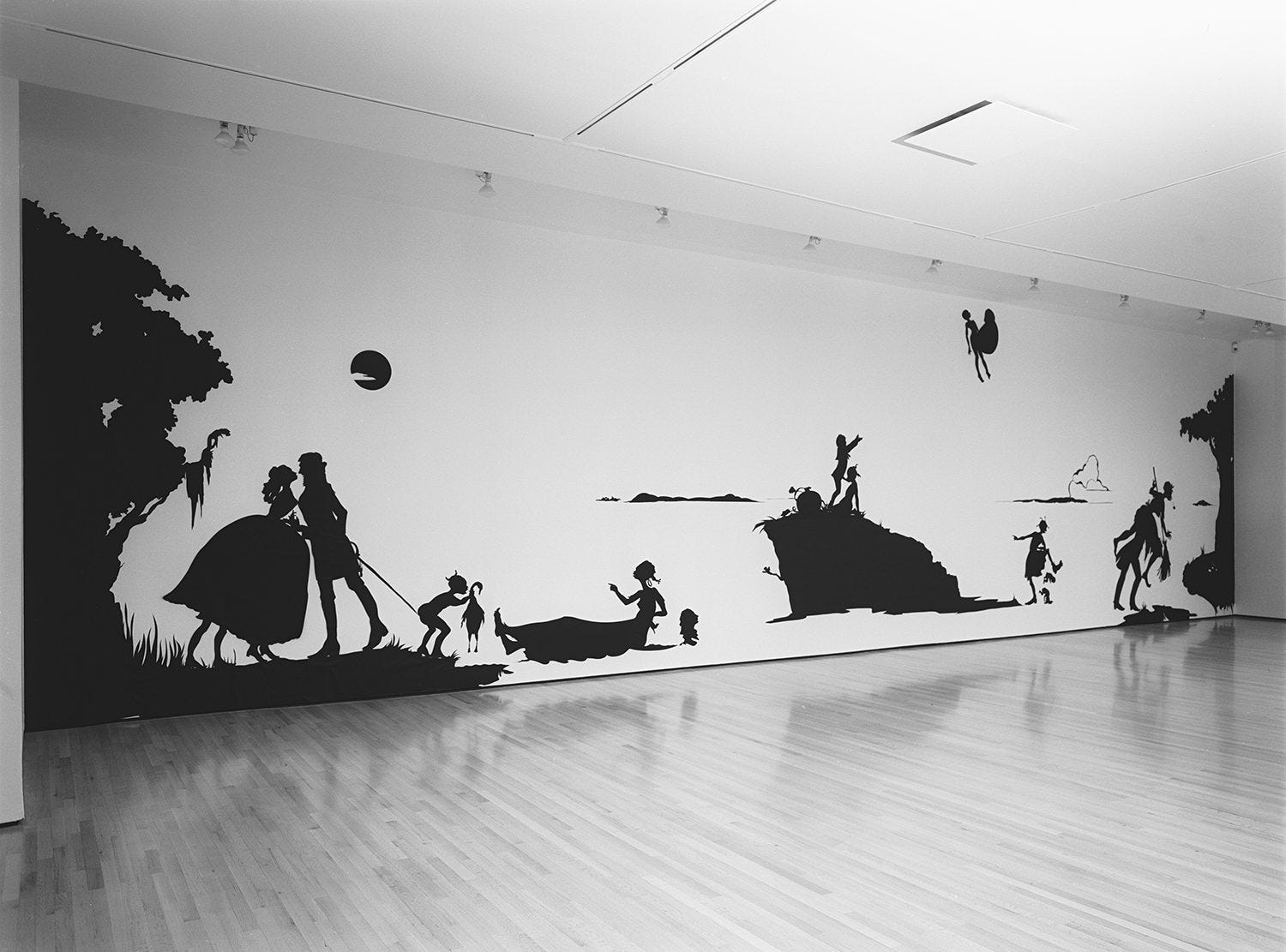
    Rewatching Kara Walker’s “Origin Story” profile on Art21, she discusses her early success with a breakout work at The Drawing Center at age 24.

    “When I came to the city, I felt like my newly forming ego and sense of self was just, like, torn to shreds.”

    She says this recalling the dramatic identity transformation that followed her graduation from RISD. She quickly fell into a prestigious art career, moving to New York from Rhode Island and teaching students her own age while serving on the faculty at Columbia University.

    Kara Walker, Gone: An Historical Romance of a Civil War as It Occurred b’tween the Dusky Thighs of One Young Negress and Her Heart, 1994. Cut paper installation. Photo: Orcutt Photo.

    The artist is supposed to want success.

    The classic rags-to-riches story asks us to imagine the arc from unknown and overlooked to recognized and celebrated as an uncomplicated ascent. But the glamorous upheaval of becoming successful can obscure the often messy experience that belies it: grieving the identity you’re leaving behind.

    Walker describes the discomfort of being given a role she wasn’t sure she wanted:

    “I don’t think I want to have the role that I was hired for, which was ‘a successful artist who was successful at a young age telling people how to get what I got.’”

    Her eyes grow big and she turns her face slightly away from the interview camera, as if she has suddenly seen herself as an actor in a stage play, stepping out of character for a moment, acknowledging the audience, the stage lights, the performance, just before delivering her next line.

    There is a mystique to the genius of her youth that rings in sharp contrast to the harsh glare of art world fame that dominated her emerging career. It’s clear her nervous system wasn’t ready.

    “But, I think I just accepted it this year that I must know something, it’s been twenty years.”

    Only with time, when the limelight faded and the novelty of her ascent became art historical lore, does she trust herself as a creative authority.

    I watch the Jack Whitten clip next.

    Whitten met his artist identity circuitously, starting out at Tuskegee as an airman and becoming a painter over multiple transformations throughout his life. Racism pushed him out of the South to New York, where he attended Cooper Union. He talks about his encounters with leading Black male painters of the 1960s—Romare Bearden, Norman Lewis, Jacob Lawrence. He’s trying to figure it out from the greats.

    “The young artist has to have something to react to.”

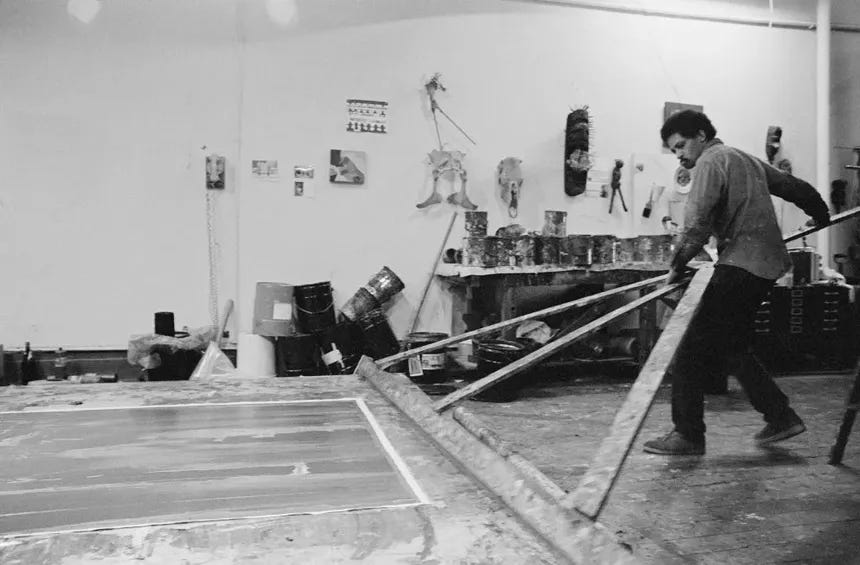
    Jack Whitten using The Developer in his studio. Photo: MOMA.

    A rupture: Whitten restructures everything.

    He makes his “slab” paintings for a decade, creating single-stroke monolithic marks with a customized heavy wooden rake he called the developer. The physical demands eventually ruin his health, forcing him to work with tesserae—smaller chunks of paint—and marking a major shift in his painting style and approach.

    This is the creative context in which we have to understand how artists learn to wield their power.

    Another rupture: Whitten becomes seriously ill and is hospitalized for a month.

    “That painting was a way of hitting back. I’m not gonna let this shit defeat me.”

    The pain had to go somewhere. Whitten put it into the work to serve a higher purpose. This is one of the powers of creative practice. It makes a space for grief to take new form and offer a different possibility.

    The grief of identity loss is the loss of a deep bond that affirmed an important part of you—a role, a romantic partner, a parent, a career. We lose a version of ourselves, and we want nothing more than to recover a sense of familiarity. The part of us that felt most visible under the beams of another’s gaze goes dark. We believe we want to recapture the light. But really, we want to recover the familiarity of who we were when we felt connected.

    “You can declare yourself an artist and then figure out how to become an artist,” Walker concludes.

    Because your creativity constructs the next identity that determines what kind of future you will live in.

    My own origin story is more straightforward. I was always an artist. But at fourteen, I lost my mother, and it made everything harder. Art became a way to live in a new world, a different timeline from the one where I seemed to suffer without purpose. I started taking art seriously in high school and then it became my career path in college. I think it’s only recently that I’ve begun detaching suffering from art-making, and have stopped extending myself in ways that make me unhappy.

    Our origin story doesn’t make us who we are. The problem comes when the identity that once helped us survive becomes another role we are expected to perform.

    In a time when we’re being coerced into becoming the lead actor, director, producer, and distributor of our own lives on behalf of a surveillance state, it’s tempting to exploit our origin stories in all of their intimate and sometimes shame-inducing detail. We’re surrounded by marketing that turns the hero’s journey into a product: courses, brands, platforms, personal narratives, optimized versions of the self.

    (Creative) suffering is the latest content funnel.

    The wound becomes the biography. The biography becomes the brand. The brand becomes something the algorithm can distribute and profit from. The artist is no longer expected to simply make the work. We are asked to become the audience-builder, the marketer, the publicist, the content creator, the personal brand.

    So what happens to the content of our connections when the artist is always performing?

    The personal planets are moving through a series of encounters with the outer planets, bringing identity, relationships, power, communication, and grief into contact with one another. Everything builds toward Wednesday’s partial solar eclipse in Leo.

    The Sun is our essential energy and focus. In Leo, it speaks to creative authority and self-expression. Then the Moon passes in front of it and the light goes dark. This is a timeline rupture. I wrote about this in last week’s essay on the Eclipse linked here.

    The self that survived the sharpest edges, the hard falls, and the deepest plunges into grief and powerlessness has gained wisdom that cannot be lost. What do we do with all this awareness?

    We need to move it through our creative expression, not through each other.

    It’s possible to feel vulnerable in our truth without using cruelty as a defense mechanism. We can learn to move difficult emotions through our creative expression rather than through the codependent behaviors of the past. We can learn to own our budding identities, accept each other’s changing selves, and make room for what wants to emerge collectively.

    Let go of who you believed you were before the rupture of this moment. Let the experience shape you, and accept the form that emerges.

    Let the origin story be part of the story without allowing it to determine the ending. That is how we make room for our greatest works to unfold.

  • Field Notes: Assembling Yourself in the Dark

    Field Notes: Assembling Yourself in the Dark

    On the Leo New Moon Eclipse, the Late Betye Saar, and Becoming through Uncertainty

    “And slowly she surrendered, opening up before him like the dark continent, made mad and delirious and blind by the entry of a mortal as bright as the morning, as white as milk.”

    —James Baldwin, Come Out the Wilderness

    The eclipses are coming.

    On August 12, a New Moon eclipse at 20° Leo opens a portal through which we transition into new forms and new realities. Eclipses denote pivot points by way of interruption. For a brief moment, the Moon obscures the Sun, interrupting our conscious sense of self and revealing what lies beneath the identities that have become well-worn comfort zones.

    With the true lunar nodes now settled on the Leo–Aquarius axis, our attention begins to shift. Aquarius points us toward the future, toward community, audience, and our place within a larger collective. Leo, meanwhile, undergoes a kind of purgation. Our attachment to recognition, certainty, performance, even our own mythology begins to lose its grip. This eclipse asks what happens when the spotlight goes dark. What remains when the parts of ourselves that crave validation are no longer seen?

    Wherever Leo falls in your birth chart, something may feel temporarily obscured. The darkness reveals what has been fueling the ego, and what has been standing between you and your heart’s desire. On August 6, Venus returns home to Libra after a month in detriment, reminding us that transformation is rarely a solitary process. Relationships begin finding their equilibrium again. Conversations become easier. We find ourselves reaching toward one another with greater generosity, even as we recognize we’re each moving through change at different speeds.

    This is why we dialogue. We need to leave our isolated bubbles long enough to discover who’s out there. We need to know who answers when we call.

    Leo has always represented creativity in its most uninhibited form. It is the child’s imagination, the thrill of making something because it feels alive. But Leo also governs spectacle. It governs what captures our attention. Its light can be so bright that we lose sight of ourselves. An eclipse temporarily interrupts that light, asking us to discover what of our creativity survives when no one is watching.

    Where do we find the opportunity for becoming within the ruins?

    I’ve been thinking about this through the life and work of the recently deceased Betye Saar.

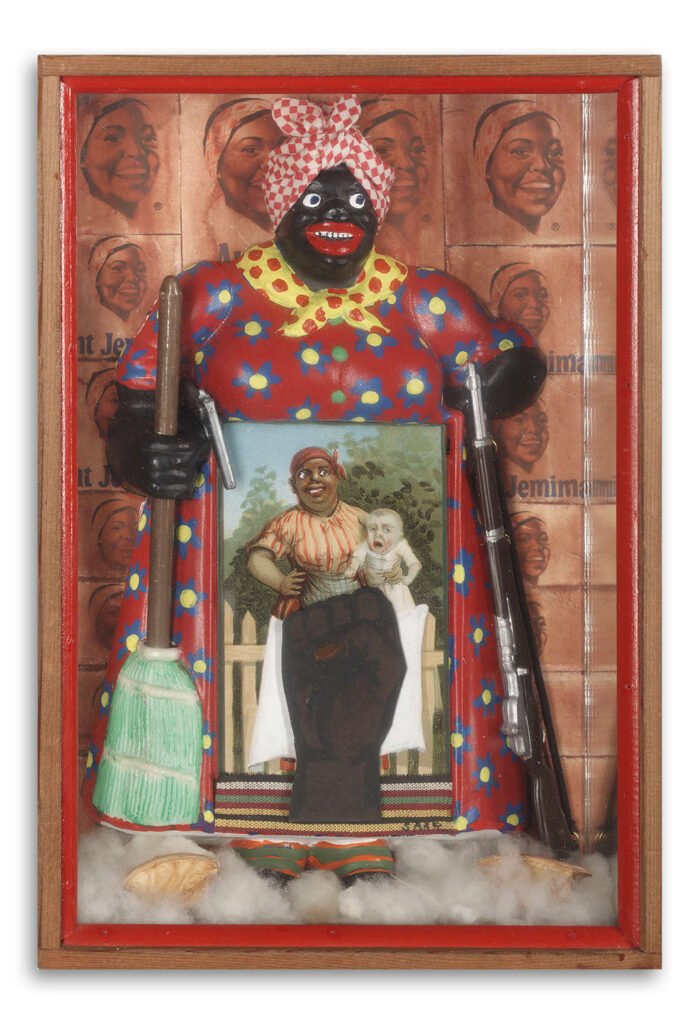
    Saar made assemblages from the discarded remains of American culture. Mammy dolls, worn wood, old photographs, American flags, cotton with the seeds still intact—objects carrying the residue of racist caricatures of Black womanhood and domestic labor became the raw materials for her rebellion. In her iconic work The Liberation of Aunt Jemima, she redirected the spotlight away from white, masculine histories of modern art and toward the fragmented identities of Black women, revealing how an inherited image can be reclaimed when its subject becomes its author.

    Betye Saar, Liberation of Aunt Jemima, 1972. Mixed media assemblage, 11.75 x 8 x 2.75 in. Photo by Benjamin Blackwell.

    In this work, Saar layers the Mammy image across three sculptural planes. The background is a washboard covered with repeating Aunt Jemima advertisements. In front of it stands a smiling Black domestic figurine holding a broom in one hand and a rifle in the other—a striking inversion that recalls Huey P. Newton’s iconic portrait. Embedded in her apron is another image of a Black woman cradling a crying white child, while a raised Black Power fist emerges from it. The familiar stereotype is no longer submissive. Saar transforms it into a figure of resistance, reclaiming an image designed to diminish Black womanhood by allowing it to speak in its own voice.

    Saar later reflected in a 2010 interview with the National Visionary Leadership Project:

    “There’s no dishonor to being a working person and having to work in the field or work as a laundress… but there is dishonor in making fun of that experience.”

    Astrologically, this impulse feels deeply reflected in her chart. Born with the North Node conjunct Pluto in Cancer, Saar spent her life excavating what American history preferred to repress: the intertwined stories of family, nation, race, belonging, and inheritance. She returned again and again to the emotional undercurrents of a country built through Black labor while denying Black humanity, using it as material to expose the contradictions at the heart of the American story and the cultural wounds around which so many identities have been organized.

    Earlier this year, Chiron entered Taurus, initiating Saar’s second Chiron return—a transit so rare that few people experience it. It echoed the Sun–Chiron square present at her birth, recalling early wounds surrounding identity, paternal loss, and survival. Her father died when she was young, and by the time she was three the nation had fallen into the Great Depression. Personal grief unfolded alongside collective collapse.

    In a 2006 interview with NPR, Saar reflected on discovering assemblage:

    “It’s like, the cement is wet, what can we put in here? I think that was the beginning of me becoming an assemblagist or recycler.”

    I hear someone looking at the wreckage of history and recognizing the possibility of another story.

    There’s something about catastrophe that changes how we perceive reality. Monumental suffering has a way of forcing people toward one another, as though the mutual reliance demanded by survival uncovers capacities for compassion we didn’t know we possessed. The familiar dissolves along with the fear of another. The boundaries between self and other soften. We begin recognizing our own humanity in someone else’s broken pieces.

    Perhaps this is why Saar’s work feels so alive today. She understood that the past doesn’t disappear simply because we refuse to look at it. It remains available to be rearranged, reimagined, and reinterpreted. Her work transformed inherited pain into cultural memory and cultural memory into possibility. She collapsed the distance between personal history and national mythology, reminding us that neither is ever complete.

    She connected the mundane to the celestial, weaving together assemblage, astrology, tarot, and spirituality into a symbolic language that suggested history itself could be divined.

    When we’re sifting through the remains of a life, something catches our eye before it catches our imagination. We follow that thread. We make the drawing. Rearrange the objects. Ruin the first attempt. Begin again. Every failed experiment becomes another conversation with ourselves. In moments like this, the artist is less concerned with preserving what was than with discovering what the remnants still have the capacity to become.

    By the time the Sun enters Virgo on August 22, the intensity of the eclipse begins to settle. Virgo asks us to organize what the eclipse has revealed. To sort through what remains with discernment, deciding what belongs in the next chapter and what does not.

    The closing Full Moon eclipse in Pisces on August 28 squares Uranus in Gemini, ensuring this transition won’t close out quietly. Expect disruption, surprise, and the disorienting feeling that your old ways of understanding yourself no longer work. Perhaps discomfort is simply the body recognizing that consciousness is catching up with change.

    Where is the most obvious removal happening in your life?

    And which parts of you have only been waiting for the light to disappear before they could finally be seen?

    This week marks a threshold. We can feel our cocoons tightening just before the moment we emerge.

    Our creativity is how we will participate in the world taking shape around us. It’s how we redefine our humanity beyond systems that reduce our worth to productivity, spectacle, or profit. The things we make will become artifacts that future humans will inherit. They will tell stories about what we valued, how we loved, what we feared, and what we believed was worth preserving.

    Hold onto whatever genuinely inspires you, whatever keeps you rooted in the present because it returns you to yourself in a way that other people can recognize. It’s all about resonance. It’s the moment someone encounters your work and says, “Yes. I know that feeling.”

    Like a lighthouse in a storm, your creativity won’t calm the sea. It simply gives you something true enough to navigate by.

    That’s how Betye Saar made room for herself in an art world that had already decided whose images deserved reverence, whose histories mattered, and whose voices would be heard. She transformed what she inherited until it spoke in her own language. We don’t need to become someone else to matter. We only need to work with what we have until we recognize ourselves in it.

  • Field Notes: The Unglamorous Labor of Becoming Yourself

    Field Notes: The Unglamorous Labor of Becoming Yourself

    The Aquarius Full Moon reveals how we find our power through one another, even as things fall apart.

    My friend, a Leo Sun, has a birthday approaching, and the weeks before her solar return have been marked by a string of mildly unfortunate events. She can’t seem to find a worthwhile date, she twisted her ankle, and she’s under review at work and suspects her employer wants her out because, despite a decade of experience and two master’s degrees, she doesn’t perform the version of Black professionalism they seem to expect.

    She admitted the role had become too easy and that she’d lost her passion for it years ago, yet she’s hardly malicious. If anything, she’s become indifferent to a workplace that no longer asks much of her.

    I reminded her that while leaving her job would be difficult, her gifts would likely be better received on the other side of an exit. Milestone moments have a way of exposing both our strengths and our growing edges. They reveal not only what we’ve outgrown, but the life that’s trying to emerge next. We often experience our greatest challenges just before crossing an important threshold, as though the moment itself is asking whether we’re willing to become someone larger than we’ve allowed ourselves to be or retreat into the familiar out of fear.

    As we talked, I applied my makeup, occasionally asking her opinion between layers of concealer and blush. What struck me wasn’t the makeup itself but how ordinary the moment felt. For years, getting dressed up carried an invisible weight, as though looking beautiful required justification or had to be earned through productivity. This felt different. This version of me wears soft glam now. There was no performance, no special occasion—just two friends talking while I prepared for an afternoon in the park.

    “Oh, you look good,” she said casually, offering exactly the affirmation I hadn’t realized I wanted.

    It was a small moment, but it stayed with me. Celebrating myself in this simple way made it easier to leave the house without feeling like I had to accomplish something for someone else or prove myself to anyone but me. Confidence, I realized, isn’t always built through dramatic transformation. Sometimes it arrives through repetition—through choosing yourself often enough that it begins to feel ordinary.

    As we discussed the crossroads in our lives, I found myself thinking about the arriving Aquarius Full Moon on July 29. As the Sun continues its journey through Leo, this week’s lunation asks a different question: not just, How do I shine? but, What do we release when our light enters the collective?

    The Moon speaks to the routines, rituals, and relationships that make life feel inhabitable. It shows us what restores us after the performance of living. In Aquarius, one of Saturn’s domiciles, that nourishment often comes from hard-won perspective. Aquarius asks us to step back from our emotional reactions long enough to examine the stories, conversations, and collective assumptions shaping them. Sometimes that distance comes through community. Sometimes through dialogue. Sometimes by noticing, almost accidentally, that we’ve already become someone new.

    This Full Moon stretches across the Leo–Aquarius axis with the Sun joined to Jupiter and the Moon joined to Pluto. Jupiter magnifies Leo’s invitation toward confidence, creativity, and self-expression, while Pluto intensifies Aquarius’ concern with power, networks, institutions, and the unseen forces that organize collective life. Together they suggest that personal transformation and structural change are unfolding simultaneously.

    The confidence we cultivate alone inevitably changes the quality of our participation with one another.

    Saturn, ruler of this lunation, remains retrograde in Aries, a sign where it struggles to express its steady, deliberate nature. Aries moves quickly; Saturn prefers patience. Aries begins; Saturn builds. Their combination can feel frustrating, exposing the limits of existing structures while slowing our ability to construct new ones. Individually, this may feel like impatience with careers, relationships, or identities we’ve outgrown. Collectively, it reflects institutions showing signs of strain under pressures they were never designed to withstand.

    Saturn is often misunderstood as morality itself, but I don’t think that’s what interests this laboring planet. Saturn represents structure, consequence, and material reality. It doesn’t reward good intentions alone; it responds to what can actually be built and sustained.

    For that reason, it wouldn’t be surprising if this Full Moon coincides with renewed attention around law enforcement, surveillance technologies, labor movements, government accountability, and widening economic inequality. Pluto in Aquarius has little interest in preserving outdated systems. It reveals the networks that both liberate and constrain us and asks which ones still deserve our participation.

    The last time the North Node occupied Aquarius and the South Node Leo, the U.S. invasion of Iraq raged on while the world reeled from the 2008 financial crisis. The election of Barack Obama carried enormous symbolic hope, yet many of the financial and political structures that had produced the crisis remained intact. That historical echo feels worth remembering as we move toward another eclipse season defined by questions of technology, power, leadership, and collective responsibility. History rarely repeats itself exactly, but it often returns carrying familiar questions in different forms.

    I keep thinking about my conversation with my friend because it mirrored not only my own process of becoming but the friction that often accompanies refusing to perform an identity that makes others comfortable. As a highly qualified Black woman, she has learned that competence alone is rarely enough. Workplaces often demand a performance alongside it—a version of professionalism shaped by expectations she did not create. The more fully she inhabits herself, the more visible those expectations become.

    Her work review became an invitation to rethink who she’d become at work. Likewise, I’ve been rethinking what creativity means outside my profession as a fine artist. For so long, I treated creativity as something that belonged to the studio, measured by exhibitions and finished work. But getting dressed that afternoon reminded me that creativity is also how I inhabit my body, choose color, shape a mood, and meet the world. It didn’t require an opening or an audience, only my participation.

    Perhaps becoming isn’t about inventing a new self at all but rather finally making room for the one that’s been trying to emerge.

    This Aquarius Full Moon is asking us to become more honest about the roles we’ve outgrown. Transformation doesn’t begin when we’re completely ready. It begins when we realize the structures that once held us can no longer contain the life that’s trying to emerge—and when we begin the patient work of building structures that can. Only then can we meet one another less as performers of inherited roles and more as participants in building something neither of us could create alone.

  • Field Notes: The Sun Comes Home

    Field Notes: The Sun Comes Home

    Returning to Yourself in Leo Season

    Lately I’ve been inhabiting someone else’s life. Like Sam Beckett in Quantum Leap, I suddenly find myself in someone else’s body, feeling strange in a familiar place and performing a role I don’t identify with.

    I move through obligations that belong to someone I barely recognize, wondering when exactly I agreed to all of this. Commitments accumulated while I wasn’t paying attention. All the while, my own desires get pushed to the back burner because it’s the right thing to do—or so I tell myself.

    So that’s what self-abandonment feels like: waking up one day inside a life assembled around everyone else’s priorities.

    Mercury’s retrograde through Cancer made these patterns impossible to ignore. Again and again, I found myself confronted with the unconscious ways I traded my own desires for the comfort of familiarity, obligation, or the illusion of security.

    Recently I had to complete a job application for a position I had already worked. The paperwork needed urgent attention, otherwise I wouldn’t get paid in a timely manner. Never mind that the check itself is already six months overdue—let me repeat the work I’ve already done so I can finally collect what I’m owed.

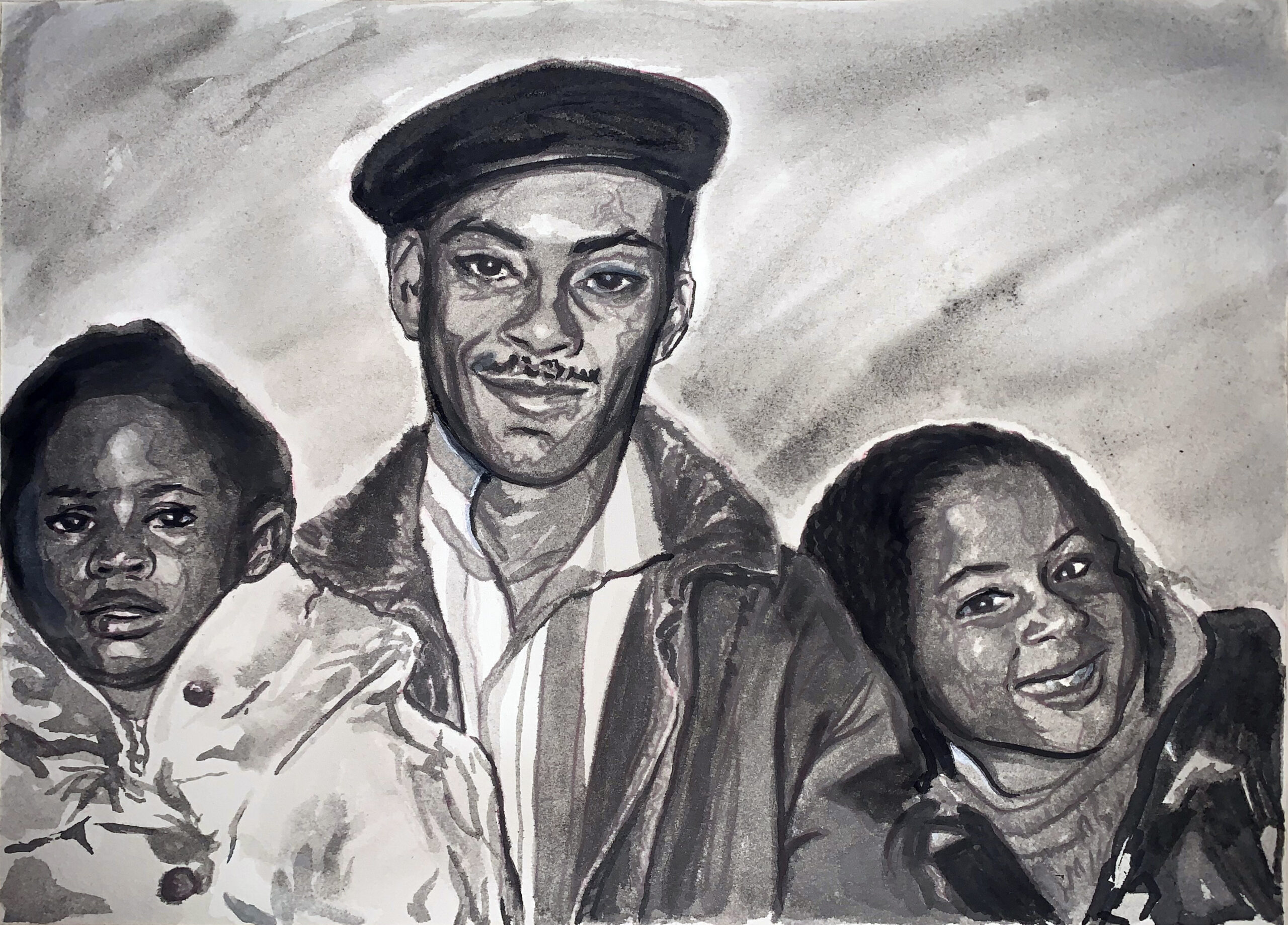
    As the Moon reached its first quarter square, I stood in line at the post office holding my father’s birthday gift. His wife had commissioned a family portrait because she knew he was nostalgic for his younger years in New York, when he was raising two daughters with my mother in a small two-bedroom apartment in Brooklyn. I called my stepmother and my sister, and we searched through old photographs until we settled on a rare one with my father in it. He was a photographer and usually behind the camera, so it was difficult to find one with him and the whole family together.

    We agreed on one where my father stood in the center holding me while my sister leaned against him. I recreated the photograph in black ink on paper using the few art supplies I’ve kept since leaving my painting studio. The drawing was more intimate than the larger paintings I once made, but its modest scale invited a different kind of attention. I sat at my kitchen table, absorbed in the tiny decisions of reconstructing faces I had once known so well.

    The portrait would make my father happy, I thought while waiting in line. It made me unexpectedly sad. In such a short time, I’d drifted so far from painting—the practice I once believed defined me.

    An old acquaintance sent me a vague message.

    Want to hang out?

    My stomach tightened, and I sighed. Do I want to hang out? What does that even mean?

    The answer was no, because saying yes would have required abandoning what I actually wanted. I’ve become fiercely protective of my creative time, and the thought of sacrificing it irritated me. In the past, I might have begrudgingly accepted simply because it was someone I once knew who asked. Nostalgia was enough to convince me that maintaining connection was more important than honoring my own time. Mercury had been teaching me that this reflex deserved scrutiny.

    What surprised me most was the fear that followed when I imagined saying no. Somewhere deep in my nervous system lives the conviction that a crisis waits on the other side of choosing myself.

    Mercury’s retrograde in Cancer traced that fear back to its roots. My self-abandonment began inside family systems where my needs felt secondary to maintaining emotional cohesion, where belonging sometimes depended on accommodating everyone else before listening to myself.

    Family once meant my mother, my father, and my sister. After my sister moved away and my mother died, it became just my father and me. These days, family is something I’ve built from chosen friends and lovers—the people listed as my “Emergency Contact.”

    My father’s birthday fell on July 22, right in the heart of this season’s intense astrology. His Sun sits on the threshold between Cancer and Leo, which somehow feels fitting. Leo is ruled by the Sun, the celestial body traditionally associated with the father. The Sun illuminates everything within its sphere, including its children.

    My father embodied that symbolism in many ways. He organized family outings, coached neighborhood sports, and was a steady presence in a community where many fathers were absent. He loved to tell people what I could do, proudly highlighting my accomplishments as though they were the most important parts of me. It was how he celebrated me.

    Looking back, I wonder whether I learned that being impressive was safer than simply being myself. My worth became entangled with my intelligence, my accomplishments, and my artistic abilities. The weirder, softer parts of me—the quirks, contradictions, and desires that didn’t earn praise—gradually receded into the background.

    When I called him on his birthday, he looked older than I remembered. His face carried the distortions promised by age, but there was still a brightness in his eyes. We talked for twenty minutes before my Chinese food arrived, ending the conversation as casually as it had begun. I hung up grateful for the call, but aware that I had heard these stories before.

    As a Leo rising, I’ve always imagined myself as someone who lived freely, someone who followed curiosity wherever it led. But trauma has a way of quietly directing your choices until survival begins masquerading as authenticity. You become so practiced at adapting that you mistake accommodation for identity.

    Perhaps that’s why this season feels less like becoming someone new and more like remembering someone I misplaced. The astrology of the coming weeks asks a deceptively simple question: What do you want?

    Not what earns approval, preserves the peace, or promises recognition and material success. What do you want?

    I want to make space to create again. I want to become obsessed with myself again, fully absorbed in my ideas without needing to justify them. I want to build a life organized around curiosity rather than obligation.

    After the flooded landscape of Cancer season, I can feel a steady flame returning—the inner fire that animates my creative self. The outlines of my own life are becoming visible again. The water is finally receding.

    Perhaps that is Leo’s real gift.

    As we collectively step into a new chapter, the future asks something different of us. Maybe the quantum leap isn’t into someone else’s life—the life we were taught to want. Maybe it when we find the courage to wake up inside our own and begin making futures that reflect what we truly desire.

  • Field Notes: It’s Not About the Cake

    Field Notes: It’s Not About the Cake

    Mercury Retrograde and the Stories that Shape our Reality

    New York spent the better part of last week lurching from one extreme to another. A days-long heatwave gave way to torrential rains that flooded streets and ripped trees from their roots. It was difficult not to see the weather as a reflection of the emotional atmosphere. Mercury stationed retrograde in Cancer on June 29, Jupiter entered Leo the following day after more than a year in Cancer, and Mars conjoined Uranus in Gemini on July 4. After a relatively quiet start to the year, July feels like an inflection point. Something big is emerging and the retrograde is revealing just how deep its roots run.   

    Mercury retrograde asks that I do my due diligence and look behind me first. I’ll be honest: it’s got me fucked up. My emotions have been all over the place, and the volatile weather here in New York has mirrored the fluctuations I’ve been feeling internally. Being forced indoors meant spending more time with myself, and that, in turn, led to some necessary conversations with the people I love.

    Mercury rules Gemini. That matters right now because Mars and Uranus met there. Mars, a hot, severing, and extracting planet, joined Uranus, a disruptive and innovative force, suggesting provocative events that arrive unexpectedly and compel action. In the US we saw fireworks and fights, and for many people this may have looked like conflict, injuries, travel interruptions, and technology failures.

    For me, Mars and Uranus manifested as a series of miscommunications that culminated in an argument with my boyfriend. It began, absurdly enough, with a slice of cake. He offered to get me dessert at a party. I asked for yellow cake with chocolate frosting and he returned with strawberry shortcake. I told him it was fine, but quietly carried the disappointment with me.

    Mercury retrograde has a way of revealing that our strongest reactions are often attached to much older conversations. Sometimes the conflict isn’t the lesson but rather the doorway into the story we’ve been unconsciously telling ourselves.

    It was never really about the cake. We’ve been talking about building a life together, and that small moment became a vessel for much older questions: Do my desires matter? Will my needs be met? What began as a misunderstanding exposed an inherited story about love and care that had been shaping my reactions long before this relationship.

    Our relationships don’t exist outside the culture that shapes them. Many of the structures and stories we’ve inherited about family, work, ambition, and care no longer sustain life. As conditions become more extreme, the gap between how we’ve been taught to live and what actually nourishes us becomes impossible to ignore.

    Our culture rewards poisoning the wells that hold our watery emotions. Jupiter’s year in Cancer revealed our thirst for nurturing life and expanded our capacity to create it.

    Now with Jupiter in Leo, the sign of the heart and joyful self-expression, we are being invited to embody authentic expressions of love and pursue joy for its own sake. Over the next year, the question becomes: How can we become more courageous in expressing the joy we want to see in the world?

    Cancer is a water sign about the home, security, and nurturing life. Sometimes the best approach isn’t confronting a problem but allowing the feelings it creates to simply exist. Mercury retrograde is forcing a review of the emotional architecture we’ve built our lives around, inviting us to reconsider the containers that hold our deepest feelings. During this Mercury retrograde, ask yourself: what conversation keeps repeating itself in your life? What feelings have you been trying to resolve with words when it might simply need to be felt?

    If Mercury retrograde in Cancer asks us to revisit the emotional stories we’ve inherited, Jupiter’s entrance into Leo asks what becomes possible once we’re no longer living inside them.

    This becomes especially meaningful with the New Moon on July 14, when the Sun and Moon join together in Cancer to begin a new cycle rooted in emotional truth. Under the Moon’s rulership, Mercury recalls the story while the New Moon asks us to rewrite it. What no longer feels true? What inherited beliefs have outlived their usefulness? What might become possible if those stories were allowed to decompose into the fertile ground of something new?

    The trees uprooted by last week’s storms now lie in cut piles along the sidewalks, waiting to become mulch. Perhaps that’s Mercury retrograde’s real invitation—not simply to uncover what has been buried, but to let old stories compost into the fertile ground from which new ones can grow.