On the Leo New Moon Eclipse, the Late Betye Saar, and Becoming through Uncertainty
“And slowly she surrendered, opening up before him like the dark continent, made mad and delirious and blind by the entry of a mortal as bright as the morning, as white as milk.”
—James Baldwin, Come Out the Wilderness
The eclipses are coming.
On August 12, a New Moon eclipse at 20° Leo opens a portal through which we transition into new forms and new realities. Eclipses denote pivot points by way of interruption. For a brief moment, the Moon obscures the Sun, interrupting our conscious sense of self and revealing what lies beneath the identities that have become well-worn comfort zones.
With the true lunar nodes now settled on the Leo–Aquarius axis, our attention begins to shift. Aquarius points us toward the future, toward community, audience, and our place within a larger collective. Leo, meanwhile, undergoes a kind of purgation. Our attachment to recognition, certainty, performance, even our own mythology begins to lose its grip. This eclipse asks what happens when the spotlight goes dark. What remains when the parts of ourselves that crave validation are no longer seen?
Wherever Leo falls in your birth chart, something may feel temporarily obscured. The darkness reveals what has been fueling the ego, and what has been standing between you and your heart’s desire. On August 6, Venus returns home to Libra after a month in detriment, reminding us that transformation is rarely a solitary process. Relationships begin finding their equilibrium again. Conversations become easier. We find ourselves reaching toward one another with greater generosity, even as we recognize we’re each moving through change at different speeds.
This is why we dialogue. We need to leave our isolated bubbles long enough to discover who’s out there. We need to know who answers when we call.
Leo has always represented creativity in its most uninhibited form. It is the child’s imagination, the thrill of making something because it feels alive. But Leo also governs spectacle. It governs what captures our attention. Its light can be so bright that we lose sight of ourselves. An eclipse temporarily interrupts that light, asking us to discover what of our creativity survives when no one is watching.
Where do we find the opportunity for becoming within the ruins?
I’ve been thinking about this through the life and work of the recently deceased Betye Saar.
Saar made assemblages from the discarded remains of American culture. Mammy dolls, worn wood, old photographs, American flags, cotton with the seeds still intact—objects carrying the residue of racist caricatures of Black womanhood and domestic labor became the raw materials for her rebellion. In her iconic work The Liberation of Aunt Jemima, she redirected the spotlight away from white, masculine histories of modern art and toward the fragmented identities of Black women, revealing how an inherited image can be reclaimed when its subject becomes its author.
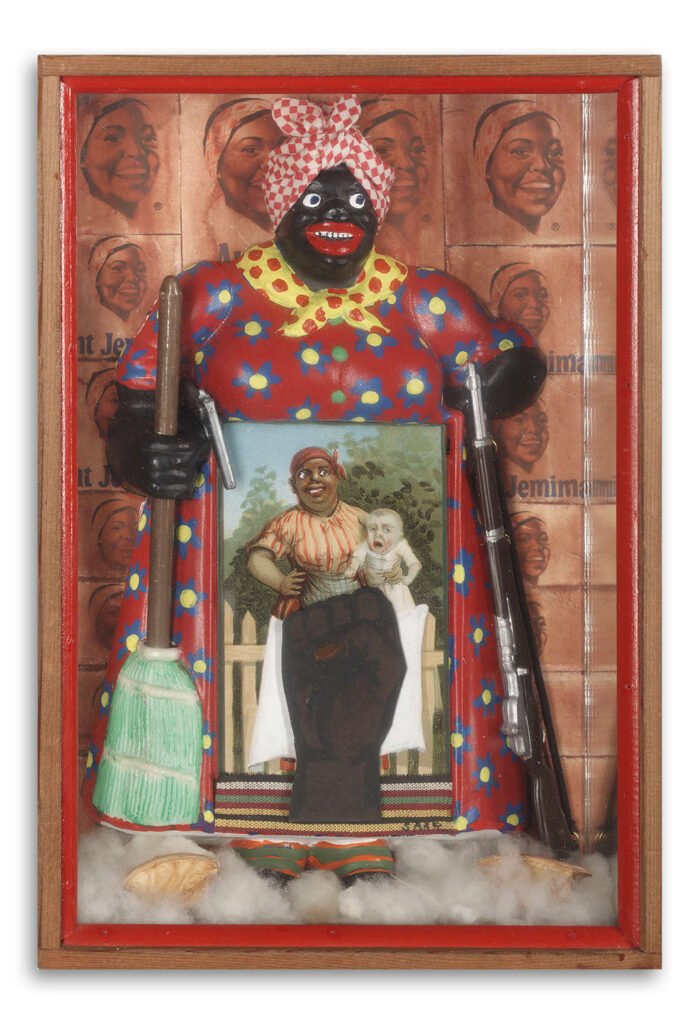
In this work, Saar layers the Mammy image across three sculptural planes. The background is a washboard covered with repeating Aunt Jemima advertisements. In front of it stands a smiling Black domestic figurine holding a broom in one hand and a rifle in the other—a striking inversion that recalls Huey P. Newton’s iconic portrait. Embedded in her apron is another image of a Black woman cradling a crying white child, while a raised Black Power fist emerges from it. The familiar stereotype is no longer submissive. Saar transforms it into a figure of resistance, reclaiming an image designed to diminish Black womanhood by allowing it to speak in its own voice.
Saar later reflected in a 2010 interview with the National Visionary Leadership Project:
“There’s no dishonor to being a working person and having to work in the field or work as a laundress… but there is dishonor in making fun of that experience.”
Astrologically, this impulse feels deeply reflected in her chart. Born with the North Node conjunct Pluto in Cancer, Saar spent her life excavating what American history preferred to repress: the intertwined stories of family, nation, race, belonging, and inheritance. She returned again and again to the emotional undercurrents of a country built through Black labor while denying Black humanity, using it as material to expose the contradictions at the heart of the American story and the cultural wounds around which so many identities have been organized.
Earlier this year, Chiron entered Taurus, initiating Saar’s second Chiron return—a transit so rare that few people experience it. It echoed the Sun–Chiron square present at her birth, recalling early wounds surrounding identity, paternal loss, and survival. Her father died when she was young, and by the time she was three the nation had fallen into the Great Depression. Personal grief unfolded alongside collective collapse.
In a 2006 interview with NPR, Saar reflected on discovering assemblage:
“It’s like, the cement is wet, what can we put in here? I think that was the beginning of me becoming an assemblagist or recycler.”
I hear someone looking at the wreckage of history and recognizing the possibility of another story.
There’s something about catastrophe that changes how we perceive reality. Monumental suffering has a way of forcing people toward one another, as though the mutual reliance demanded by survival uncovers capacities for compassion we didn’t know we possessed. The familiar dissolves along with the fear of another. The boundaries between self and other soften. We begin recognizing our own humanity in someone else’s broken pieces.
Perhaps this is why Saar’s work feels so alive today. She understood that the past doesn’t disappear simply because we refuse to look at it. It remains available to be rearranged, reimagined, and reinterpreted. Her work transformed inherited pain into cultural memory and cultural memory into possibility. She collapsed the distance between personal history and national mythology, reminding us that neither is ever complete.
She connected the mundane to the celestial, weaving together assemblage, astrology, tarot, and spirituality into a symbolic language that suggested history itself could be divined.
When we’re sifting through the remains of a life, something catches our eye before it catches our imagination. We follow that thread. We make the drawing. Rearrange the objects. Ruin the first attempt. Begin again. Every failed experiment becomes another conversation with ourselves. In moments like this, the artist is less concerned with preserving what was than with discovering what the remnants still have the capacity to become.
By the time the Sun enters Virgo on August 22, the intensity of the eclipse begins to settle. Virgo asks us to organize what the eclipse has revealed. To sort through what remains with discernment, deciding what belongs in the next chapter and what does not.
The closing Full Moon eclipse in Pisces on August 28 squares Uranus in Gemini, ensuring this transition won’t close out quietly. Expect disruption, surprise, and the disorienting feeling that your old ways of understanding yourself no longer work. Perhaps discomfort is simply the body recognizing that consciousness is catching up with change.
Where is the most obvious removal happening in your life?
And which parts of you have only been waiting for the light to disappear before they could finally be seen?
This week marks a threshold. We can feel our cocoons tightening just before the moment we emerge.
Our creativity is how we will participate in the world taking shape around us. It’s how we redefine our humanity beyond systems that reduce our worth to productivity, spectacle, or profit. The things we make will become artifacts that future humans will inherit. They will tell stories about what we valued, how we loved, what we feared, and what we believed was worth preserving.
Hold onto whatever genuinely inspires you, whatever keeps you rooted in the present because it returns you to yourself in a way that other people can recognize. It’s all about resonance. It’s the moment someone encounters your work and says, “Yes. I know that feeling.”
Like a lighthouse in a storm, your creativity won’t calm the sea. It simply gives you something true enough to navigate by.
That’s how Betye Saar made room for herself in an art world that had already decided whose images deserved reverence, whose histories mattered, and whose voices would be heard. She transformed what she inherited until it spoke in her own language. We don’t need to become someone else to matter. We only need to work with what we have until we recognize ourselves in it.
Leave a Reply