Chiron and De-centering the Wound to Become More Yourself
The turning point of an artist’s early life often becomes their origin story. We live a life, creative or otherwise, until some turn of events crescendos into a rupture that separates us from the identity that kept us safe until that point. The rupture represents a loss. The loss becomes grief, and that grief can form the foundation of the artistic identity we become known for.
Creatively speaking, what happens when the grief of that origin stops being the center of your identity?
Rewatching Kara Walker’s “Origin Story” profile on Art21, she discusses her early success with a breakout work at The Drawing Center at age 24.
“When I came to the city, I felt like my newly forming ego and sense of self was just, like, torn to shreds.”
She says this recalling the dramatic identity transformation that followed her graduation from RISD. She quickly fell into a prestigious art career, moving to New York from Rhode Island and teaching students her own age while serving on the faculty at Columbia University.
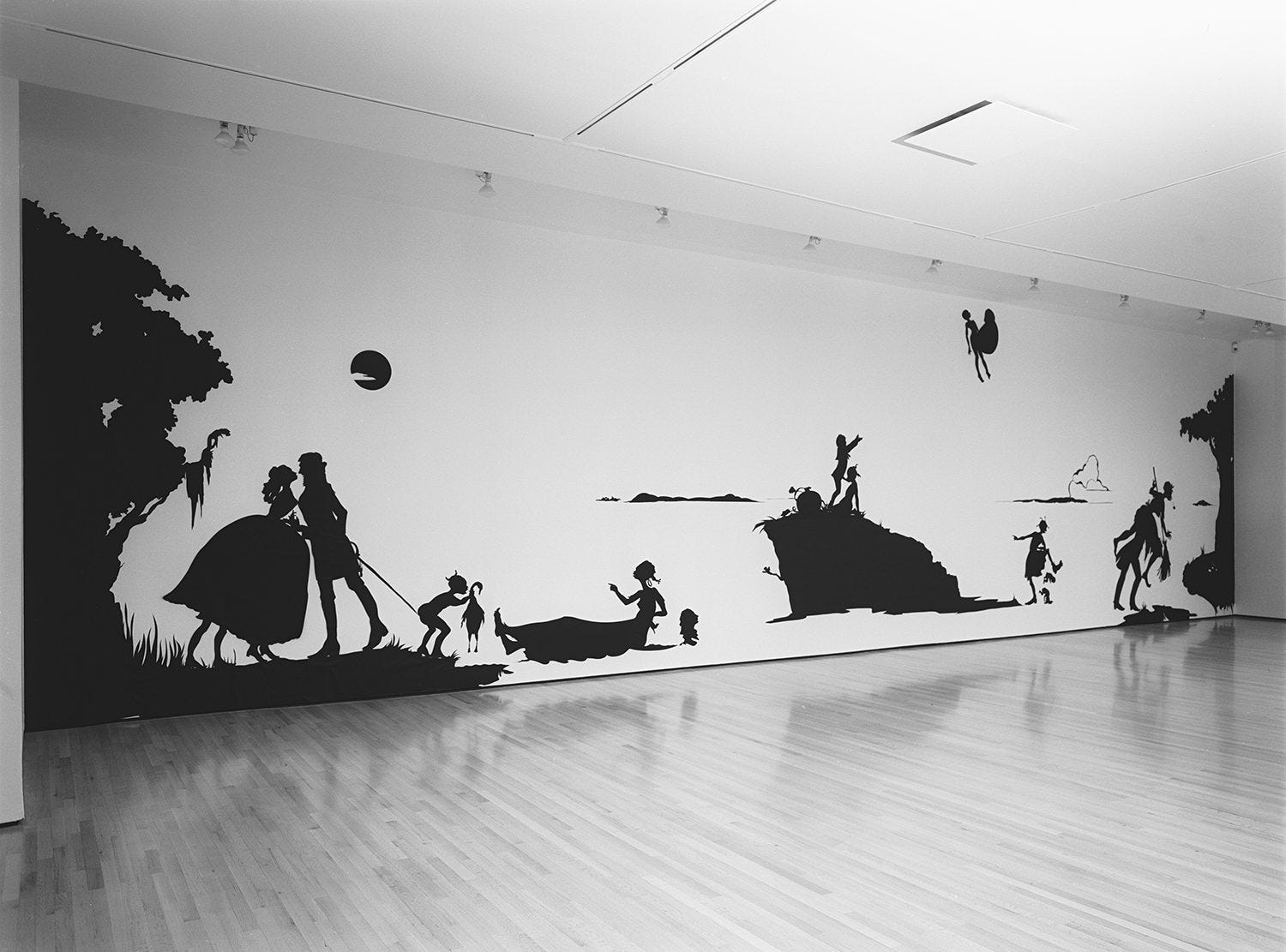
The artist is supposed to want success.
The classic rags-to-riches story asks us to imagine the arc from unknown and overlooked to recognized and celebrated as an uncomplicated ascent. But the glamorous upheaval of becoming successful can obscure the often messy experience that belies it: grieving the identity you’re leaving behind.
Walker describes the discomfort of being given a role she wasn’t sure she wanted:
“I don’t think I want to have the role that I was hired for, which was ‘a successful artist who was successful at a young age telling people how to get what I got.’”
Her eyes grow big and she turns her face slightly away from the interview camera, as if she has suddenly seen herself as an actor in a stage play, stepping out of character for a moment, acknowledging the audience, the stage lights, the performance, just before delivering her next line.
There is a mystique to the genius of her youth that rings in sharp contrast to the harsh glare of art world fame that dominated her emerging career. It’s clear her nervous system wasn’t ready.
“But, I think I just accepted it this year that I must know something, it’s been twenty years.”
Only with time, when the limelight faded and the novelty of her ascent became art historical lore, does she trust herself as a creative authority.
I watch the Jack Whitten clip next.
Whitten met his artist identity circuitously, starting out at Tuskegee as an airman and becoming a painter over multiple transformations throughout his life. Racism pushed him out of the South to New York, where he attended Cooper Union. He talks about his encounters with leading Black male painters of the 1960s—Romare Bearden, Norman Lewis, Jacob Lawrence. He’s trying to figure it out from the greats.
“The young artist has to have something to react to.”
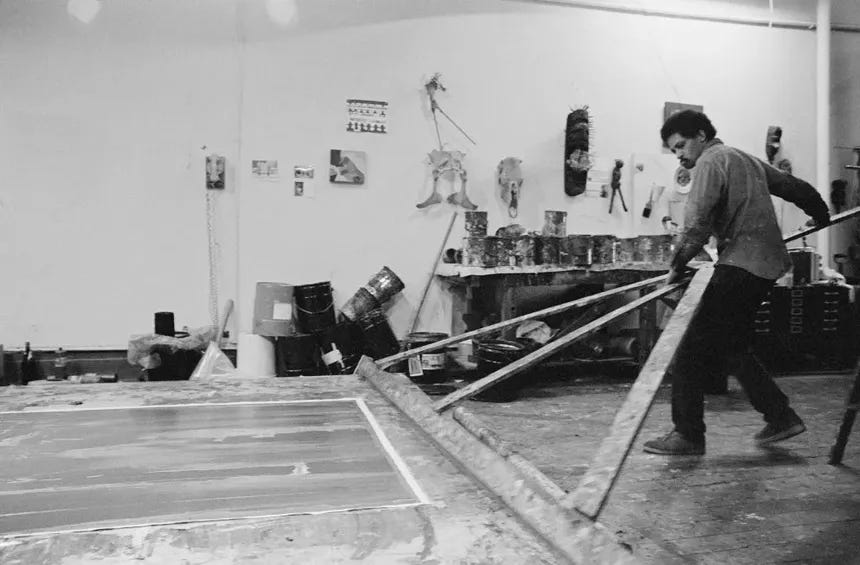
A rupture: Whitten restructures everything.
He makes his “slab” paintings for a decade, creating single-stroke monolithic marks with a customized heavy wooden rake he called the developer. The physical demands eventually ruin his health, forcing him to work with tesserae—smaller chunks of paint—and marking a major shift in his painting style and approach.
This is the creative context in which we have to understand how artists learn to wield their power.
Another rupture: Whitten becomes seriously ill and is hospitalized for a month.
“That painting was a way of hitting back. I’m not gonna let this shit defeat me.”
The pain had to go somewhere. Whitten put it into the work to serve a higher purpose. This is one of the powers of creative practice. It makes a space for grief to take new form and offer a different possibility.
The grief of identity loss is the loss of a deep bond that affirmed an important part of you—a role, a romantic partner, a parent, a career. We lose a version of ourselves, and we want nothing more than to recover a sense of familiarity. The part of us that felt most visible under the beams of another’s gaze goes dark. We believe we want to recapture the light. But really, we want to recover the familiarity of who we were when we felt connected.
“You can declare yourself an artist and then figure out how to become an artist,” Walker concludes.
Because your creativity constructs the next identity that determines what kind of future you will live in.
My own origin story is more straightforward. I was always an artist. But at fourteen, I lost my mother, and it made everything harder. Art became a way to live in a new world, a different timeline from the one where I seemed to suffer without purpose. I started taking art seriously in high school and then it became my career path in college. I think it’s only recently that I’ve begun detaching suffering from art-making, and have stopped extending myself in ways that make me unhappy.
Our origin story doesn’t make us who we are. The problem comes when the identity that once helped us survive becomes another role we are expected to perform.
In a time when we’re being coerced into becoming the lead actor, director, producer, and distributor of our own lives on behalf of a surveillance state, it’s tempting to exploit our origin stories in all of their intimate and sometimes shame-inducing detail. We’re surrounded by marketing that turns the hero’s journey into a product: courses, brands, platforms, personal narratives, optimized versions of the self.
(Creative) suffering is the latest content funnel.
The wound becomes the biography. The biography becomes the brand. The brand becomes something the algorithm can distribute and profit from. The artist is no longer expected to simply make the work. We are asked to become the audience-builder, the marketer, the publicist, the content creator, the personal brand.
So what happens to the content of our connections when the artist is always performing?
The personal planets are moving through a series of encounters with the outer planets, bringing identity, relationships, power, communication, and grief into contact with one another. Everything builds toward Wednesday’s partial solar eclipse in Leo.
The Sun is our essential energy and focus. In Leo, it speaks to creative authority and self-expression. Then the Moon passes in front of it and the light goes dark. This is a timeline rupture. I wrote about this in last week’s essay on the Eclipse linked here.
The self that survived the sharpest edges, the hard falls, and the deepest plunges into grief and powerlessness has gained wisdom that cannot be lost. What do we do with all this awareness?
We need to move it through our creative expression, not through each other.
It’s possible to feel vulnerable in our truth without using cruelty as a defense mechanism. We can learn to move difficult emotions through our creative expression rather than through the codependent behaviors of the past. We can learn to own our budding identities, accept each other’s changing selves, and make room for what wants to emerge collectively.
Let go of who you believed you were before the rupture of this moment. Let the experience shape you, and accept the form that emerges.
Let the origin story be part of the story without allowing it to determine the ending. That is how we make room for our greatest works to unfold.
Leave a Reply